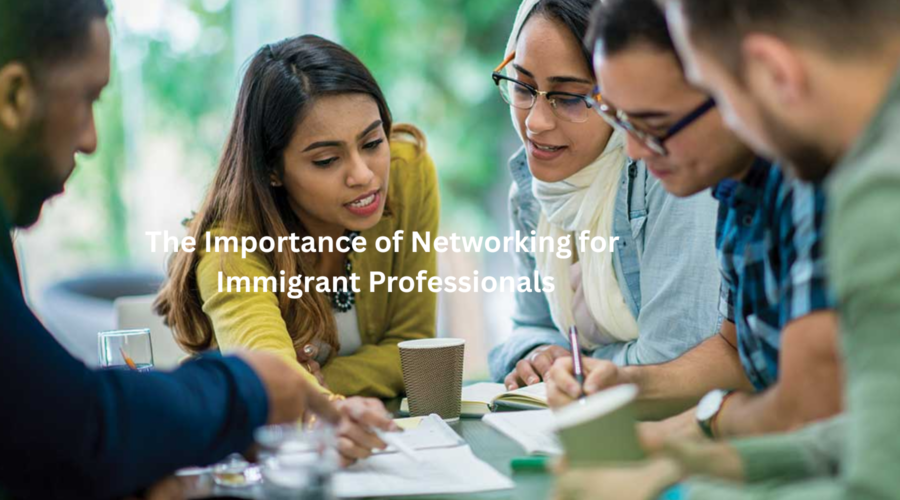
The Importance of Networking for Immigrant Professionals
There’s a particular kind of loneliness that comes with starting over in a new country. You carry your degrees, your experience, your work ethic -sometimes decades of it -and yet you find yourself standing at the edge of an unfamiliar professional landscape, unsure of where to begin. No one tells you that the hardest part of building a career abroad isn’t the language barrier or the credential recognition process. It’s the absence of people who know your name.
For immigrant professionals, networking isn’t a career strategy. It’s survival.
The Hidden Job Market Is Real-And It’s Locked Behind Relationships
Studies consistently suggest that a significant portion of jobs -often cited as 70-80 percent -are never publicly advertised. They’re filled through referrals, casual coffee conversations, and recommendations passed between colleagues who trust each other. For someone who has just arrived in a country, that system is effectively invisible.
Local professionals have spent years, sometimes their entire adult lives, building the social capital that feeds into this hidden market. They went to university with the hiring manager’s college roommate. They coached their kids on the same football team. These aren’t unfair advantages born of malice -they’re just the natural accumulation of proximity over time. The problem is that proximity takes time to build, and immigrants are starting from zero.
This is precisely why deliberate, intentional networking matters so much. You cannot afford to wait for organic connections to form. You have to go looking for them.
Networking Humanizes Your Resume
Hiring decisions, despite what we’d like to believe, are rarely made on paper alone. A resume gets you a foot in the door, but it’s a person who gets you through it. When a local contact vouches for you — even informally, even just by saying “I met this person at an event and they really know their stuff” — it transforms you from an unknown name with a foreign university on your CV into someone with credibility.
This matters enormously for immigrants, whose qualifications are sometimes viewed with skepticism simply because they come from unfamiliar institutions. A strong professional endorsement can cut through that bias far more effectively than any perfectly formatted document.
Networking gives people a face to attach to your experience. It makes you real in a way that paper never can.
It’s About Learning the Unwritten Rules
Every professional environment has two sets of rules: the ones written in employee handbooks, and the ones nobody ever writes down but everybody somehow knows. How do you address senior colleagues — by first name or title? Is it acceptable to push back in a meeting, or does dissent happen only behind closed doors? What counts as “being assertive” versus “being difficult”?
These cultural codes vary enormously, not just between countries but between industries and even individual companies. Immigrants who network actively learn these norms faster. They pick up nuances through observation and honest conversation in ways that no orientation session can teach. They hear things like, “Oh, just so you know, our director prefers short emails — bullet points only,” or “Promotions here are really about visibility, not just results.”
That kind of intelligence is priceless. And it flows almost exclusively through relationships.
Mentorship Changes the Trajectory
There is a meaningful difference between having a mentor and receiving generic career advice. A mentor who has navigated a similar journey — perhaps another immigrant professional who built their career in the same field and city — can shortcut years of trial and error. They know which certifications are worth pursuing and which are empty credentials. They know which companies have genuinely inclusive cultures and which ones say the right things on their website. They can make an introduction that opens a door you didn’t even know existed.
Finding this kind of mentorship rarely happens by accident. It comes from showing up at industry events, professional associations, immigrant community organizations, and alums networks. It comes from being genuinely curious about other people’s paths and honest about your own.
Many successful immigrant professionals will tell you that a single relationship, the right person who believed in them early on, changed everything. That relationship had to start somewhere.
Giving Back Creates Lasting Capital
One of the most counterintuitive truths about networking is that it works best when you stop thinking about what you can get from it. The professionals who build the richest networks over time are the ones who show up with something to offer — a skill, a perspective, a connection, a bit of knowledge.
Immigrant professionals carry something genuinely rare: they’ve operated across cultures, navigated systems under pressure, often mastered multiple languages, and developed an adaptive problem-solving that comes from necessity. These are not small things. They are tremendous professional assets, and sharing them builds goodwill that compounds over the years.
Mentor a newer arrival. Volunteer your skills for a community organization. Speak at an event about your field. Join a professional board. These acts of generosity aren’t charity — they’re investments in a network that will eventually get back to you in ways you can’t predict.
Where to Begin When It All Feels Overwhelming
The blank page of a new professional network is daunting. But you don’t have to fill it all at once. Start with one professional association in your field. Attend one local meetup. Connect with one person from your university’s alum network in your new city. Reach out to one immigrant professional in your industry whose work you admire and ask for a 20-minute conversation.
Be patient with yourself. Trust that every genuine conversation is a deposit in an account whose value isn’t immediately visible.
Professional success in a new country is rarely a solo achievement. Behind almost every immigrant professional who has broken through, built something meaningful, and found their footing, there are some people who helped them get there. The job now is to find yours.