
Outdoor Lighting Ideas to Enhance Your Canadian Home’s Curb Appeal
Most Canadian homeowners put a lot of thought into how their front yard looks during the day. The lawn gets mowed, the beds get planted, and the pathway gets edged. It all looks great on a Saturday afternoon in June. And then the sun goes down, and the whole thing disappears into darkness.
Here’s the part that doesn’t get talked about enough. Canada is dark for a significant portion of the year. From October through March, most people leave for work before sunrise and come home after sunset. Your home sits in darkness for nearly half the year, for most of the evening hours. If your landscaping only performs in daylight, you are genuinely missing half of your home’s curb appeal potential.
Outdoor lighting changes that equation completely. A front yard that is thoughtfully lit after dark looks warm, welcoming, and cared for in a way that actually stands out more at night than it does during the day — because most of the competition goes dark while yours stays alive. It’s one of the highest-impact, most underutilized improvements available to Canadian homeowners, and the cost of getting it right is far lower than most people assume.
Start By Understanding What Lighting Actually Does for a Front Yard
Before getting into specific ideas, it’s worth being clear about what good outdoor lighting is actually trying to achieve. It’s not about flooding your front yard with brightness. Overlighting is a real problem, creating a harsh, flat appearance that looks more like a car park than a welcoming home.
Good outdoor lighting is about contrast and emphasis. It’s about picking the elements of your front yard that are worth highlighting — a beautiful tree, an interesting texture, the pathway to your door — and drawing attention to them selectively while leaving other areas in softer shadow. That contrast is what creates depth and visual interest after dark.
Think about how a well-lit restaurant or hotel entrance looks in the evening. It’s never flooded with uniform brightness. It has layers — some things lit, some things shadowed, warm tones that feel inviting rather than clinical. That’s exactly the effect you’re aiming for at the front of your home.
Pathway Lights — The Foundation of Any Good Outdoor Lighting Plan
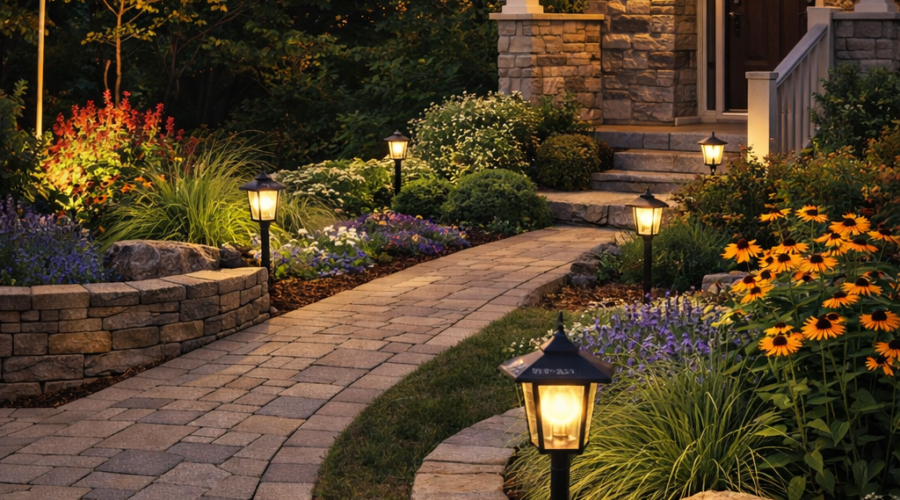
If you start nowhere else, start here. Pathway lights along the walkway from your driveway or street to your front door serve two purposes simultaneously — they’re practical, making it safe and easy to navigate after dark, and they’re decorative, defining the approach to your home and creating a sense of arrival that looks genuinely lovely on a dark November evening.
The key with pathway lights is consistency and restraint. Space them evenly — typically around six to eight feet apart on alternating sides of the path — and choose a height that illuminates the walking surface without shining directly into anyone’s eyes. Low-profile fixtures that cast their light downward and outward work far better than taller ones that create glare.
Solar pathway lights have improved dramatically over the past several years, and the better quality ones now provide reliable illumination through Canadian winters without any wiring or ongoing running costs. They do need a reasonable amount of daylight to charge effectively, which can be a limitation during the shortest days of December and January in northern locations. If reliability during the darkest months matters to you, low-voltage hardwired LED pathway lights connected to a simple timer are worth the additional installation cost.
Either way, stick to warm white light — somewhere around 2700 to 3000 Kelvin. Cool white or daylight bulbs look harsh and clinical in a residential landscape. Warm tones feel welcoming and complement the natural materials in most Canadian front yards far better than cool tones do.
Uplighting — How to Make Trees and Shrubs Look Extraordinary After Dark
This is the technique that makes the biggest visual impact per dollar spent, and yet most Canadian homeowners have never tried it. Uplighting means placing a fixture at ground level, aimed upward, toward a tree, large shrub, or architectural feature. The result, especially on a mature tree with interesting bark or branch structure, is genuinely dramatic.
A single well-placed uplight at the base of a feature tree in your front yard creates a focal point after dark that is visible from down the street. It adds height and drama to your landscape in a way that no daytime planting achieves. On a dark winter evening, when the tree is bare, the branch structure, lit from below, has an almost sculptural quality that looks beautiful against a dark sky.
Evergreens respond particularly well to uplighting. A cedar or blue spruce lit from the base glows in a rich, deep green that looks completely different — and frankly better — than it does in flat daylight. If you have foundation planting along the front of your house, a row of small uplights aimed at those shrubs creates a warm, layered glow across the entire facade, transforming how your home reads from the street after dark.
Use narrow-beam fixtures for tall trees where you want to emphasize height, and wider-beam fixtures for spreading shrubs and foundation planting where you want to create a broader wash of light. Brass or dark bronze fixtures that sit at ground level blend into the landscape during the day and essentially disappear until they turn on in the evening.
Wall Lighting and Entry Fixtures — What Most People Get Wrong
The light fixture beside your front door is one of the most noticeable elements of your home’s exterior. Yet it’s remarkable how many Canadian homes have fixtures that are the wrong scale, the wrong style, or so old and tired-looking that they undermine everything else.
The most common mistake is choosing a fixture that is too small for the space. A front door fixture should be substantial enough to read clearly from the street. As a rough guide, the height of the fixture should be somewhere around one-quarter to one-third the height of the door. Most people err on the side of too small, and the result is a fixture that looks like an afterthought rather than a design choice.
Style consistency matters here more than people realize. Your entry fixture should relate to the architectural character of your home. A sleek, modern lantern looks out of place on a traditional brick colonial. A period-style coach light looks equally out of place on a contemporary home with clean lines and dark cladding. Take a step back and look at your home’s overall style before choosing a fixture rather than just picking something that looks nice in the store.
If your front entry has flanking windows or sidelights beside the door, matching sconces on either side, rather than a single central fixture, create a more balanced and welcoming appearance. The symmetry is clear from the street and gives the entrance a finished quality that a single fixture rarely achieves on its own.
Consider the color temperature of your entry fixture carefully. It should match or closely complement the other lighting in the front yard. A warm white entry fixture paired with cool white pathway lights creates a visual disconnect that feels slightly off, yet most people can’t identify why.
Accent Lighting for Architectural Features — The Detail That Separates Good From Great
Most front yard lighting plans focus on plants, pathways, and the front door. The homeowners whose outdoor lighting really stands out take one additional step — they look at the house’s architecture and identify elements worth highlighting.
Interesting stonework on the facade. A pronounced roofline or gable. A covered porch with timber elements. Brick detailing around a window. These architectural features, largely taken for granted during the day, can become genuine focal points after dark with the right lighting.
Grazing light — where a fixture is placed close to a surface and aimed across it at a low angle — brings out texture in a way that front-on lighting completely flattens. A grazing light aimed across a stone or brick facade picks up every variation in the surface, creating a rich, three-dimensional appearance that looks completely different from the flat daytime view.
Wall-mounted fixtures specifically designed for facade lighting are available in low-voltage LED formats that use very little energy and require no maintenance. The installation is relatively straightforward for a licensed electrician, and the visual impact is completely disproportionate to the cost involved.
Practical Considerations for Canadian Outdoor Lighting
A few things worth knowing before you start planning your outdoor lighting, specific to Canadian conditions.
All outdoor fixtures need to be rated for outdoor use — this sounds obvious, but it’s worth double-checking. In Canada specifically, look for fixtures with an appropriate wet location rating, given the combination of rain, snow, and ice they’ll be exposed to. Cheap fixtures with inadequate weatherproofing fail quickly in Canadian winters, and replacing them every few years eliminates any cost savings from going cheap in the first place.
LED is the only sensible choice for Canadian outdoor lighting in 2025. The technology has advanced to the point where there is no meaningful performance argument for incandescent or halogen fixtures outdoors. LED lights use a fraction of the energy, last much longer, handle cold temperatures better, and are available in the full range of color temperatures and beam angles you need for any application.
Timers and photocell controls are worth the small additional cost. A photocell that turns your lights on automatically at dusk and off at a set time keeps your home lit when it should be, without any daily management from you. In the depths of a Canadian winter when it’s dark by four-thirty in the afternoon, this kind of automation makes a real practical difference.
Putting It All Together
The front yards that look genuinely impressive after dark in Canadian neighborhoods all share a common approach. They have layers. Pathway lights define the ground level. Uplights add height and drama. Entry fixtures frame the door. Accent lighting highlights the architecture. No single element does everything — it’s the combination of layers that creates depth and visual richness.
You don’t need to do it all at once. Start with pathway lights if you have nothing. Add an uplight on your best front yard tree next season. Replace the entry fixture when you’re ready. Build the layers gradually, and each addition makes everything already in place look better.
In Canada, your home spends half the year in darkness. The homes that look great after dark are the ones people remember.
Start with one element this season and see what a difference it makes on a dark evening. The results will tell you exactly what to add next.