
Hardscaping Ideas That Instantly Boost Curb Appeal in Canada
A conversation comes up constantly among Canadian homeowners who are trying to improve their front yards. They plant flowers in spring, the flowers look great through summer, and then October arrives, and everything dies back. By November, the yard looks bare and flat and honestly a bit sad. They do the whole thing again the following year with the same result.
The missing piece in most of those yards isn’t more plants. Its structure.
Hardscaping — the non-living elements of your landscape, such as pathways, walls, driveways, steps, and borders — gives a front yard its bones. It’s what makes a yard look designed rather than just planted. And unlike flowers and perennials, hardscaping doesn’t disappear in October. It sits there through every Canadian winter looking solid and intentional, carrying your curb appeal through the months when nothing else can.
If your front yard looks great in July but forgettable by December, hardscaping is what you’re missing.
Why Hardscaping Works Especially Well in Canada
Before getting into specific ideas, it’s worth understanding why hardscaping matters even more in Canada than it does in milder climates.
Canadian winters are long. Depending on where you live, you’re looking at four to six months where the ground is frozen, plants are dormant, and your front yard is essentially whatever structure exists underneath the snow. A yard with strong hardscaping elements — defined edges, a well-built pathway, interesting stonework — looks completely different under a layer of snow than a yard that has nothing but flat lawn and empty beds.
There’s also the practical reality of freeze-thaw cycles. Canada’s climate is particularly hard on materials that aren’t designed for it. Cheap concrete cracks. Poorly installed interlocking stone shifts and heaves. Wood rots faster than most people expect. When you invest in hardscaping in Canada, choosing the right materials and installing them properly isn’t optional — it’s the difference between something that looks great for twenty years and something that looks like a problem within three.
Good hardscaping done right in Canada lasts a very long time and requires almost no maintenance. That’s a different calculation than plants, which need annual attention and replacement. It’s an upfront investment that quietly earns its keep for decades.
The Pathway — The Most Impactful Hardscaping Element You Can Add
If your front yard has one hardscaping priority, it’s the pathway from the street or driveway to your front door. Nothing else you do to your exterior makes as immediate or as lasting an impression as a well-designed, properly built front pathway.
Here’s why. The pathway is the line that guides every single visitor toward your home. It tells people where to walk, creates a sense of arrival, and frames the approach to your front door in a way that either feels considered and welcoming or vague and unfinished. A strong pathway doesn’t just function well — it makes the whole front yard look like it was designed with intention.
Natural stone is the premium choice and for good reason. Flagstone, limestone, and granite all look genuinely beautiful, handle Canadian freeze-thaw conditions extremely well when properly installed, and age gracefully over time in a way that manufactured materials don’t always manage. The upfront cost is higher, but the longevity and appearance justify it for most homeowners.
Interlocking concrete pavers are the practical middle ground. They’re more affordable than natural stone, highly durable in Canadian conditions, and available in a wide range of colors and patterns that complement virtually any home style. They’re also repairable — if one paver shifts or cracks, you can lift and replace it individually without touching the rest.
Whatever material you choose, get the base preparation right. In Canada, this means a properly compacted gravel base, deep enough to withstand frost movement — typically 6 to 8 inches. Paths that fail in Canadian winters almost always fail because of an inadequate base, not because of the surface material. Do the base properly, and your pathway will still look great twenty years from now.
Retaining Walls — Function and Beauty in the Same Structure
A lot of Canadian front yards have grade changes — areas where the ground slopes or drops between the lawn and the street, or between different parts of the yard. Most homeowners treat these as a challenge to work around. The smarter approach is to treat them as an opportunity.
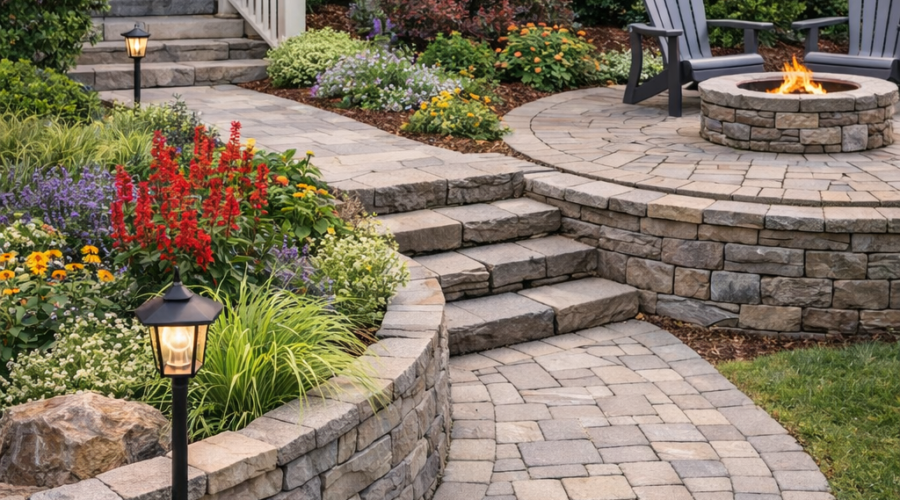
A well-built retaining wall turns an awkward slope into one of the most visually interesting features of your front yard. It creates distinct levels, adds architectural interest, and gives you raised planting beds that look a thousand times more deliberate than plants just stuck in a slope.
Natural stone retaining walls have a timeless quality that suits Canadian landscapes particularly well. The texture and variation in natural stone give a wall a permanence and character that manufactured blocks struggle to replicate. For a cottage-style or traditional home, a dry-laid fieldstone wall is almost unbeatable for curb appeal.
Concrete retaining wall blocks are the more affordable and more commonly used option. Modern manufactured blocks come in shapes and finishes that do a reasonable impression of natural stone, and they’re engineered specifically for Canadian climate conditions. When the job is done well with proper drainage behind the wall, they hold up extremely reliably through decades of freeze-thaw cycles.
One thing worth knowing about retaining walls over a certain height — typically around one meter in most Canadian municipalities — is that they often require a permit and engineering sign-off. Check with your local municipality before building anything significant. It’s not a reason to avoid them, but it’s worth knowing before you start.
Front Steps — The Hardscaping Element Right Under Everyone’s Nose
Stand at the end of your driveway and look at your home. Where do your eyes go? Almost certainly to the front door. And what leads to the front door? The steps.
Front steps are one of those hardscaping elements that people notice constantly without consciously registering why. Well-built, properly proportioned steps that suit the home’s style feel right in a way that’s hard to articulate. Cracked, uneven, or poorly designed steps create a nagging sense that something is off — even when the viewer can’t quite put their finger on what it is.
If your existing front steps are concrete that has seen better days, the options range from a full replacement to a stone veneer overlay that transforms the appearance without the cost of a full replacement. Natural stone treads on top of existing concrete steps are a relatively affordable upgrade that makes an enormous visual difference and holds up well in Canadian conditions.
Proportion matters here. Steps that are too narrow feel unwelcoming. Steps that are too steep feel unsafe. The general guideline for comfortable exterior steps is a tread depth of about 12 inches and a riser height of about 6 inches. These dimensions feel natural to walk up, and they look right from the street.
Adding a simple landing at the top — a wider, flat area right at the front door — dramatically elevates the entire entrance area. It gives the front door room to breathe and creates a welcoming pause before you enter the home.
Driveway Edging — The Detail That Pulls Everything Together
A driveway that ends where the lawn begins looks unfinished. It’s one of those details that most homeowners don’t consciously notice, but that experienced landscapers and real estate agents pick up on immediately.
Edging along the driveway — whether with a row of natural stone, concrete curbing, interlocking pavers, or even just a cleanly maintained planted border — gives the whole front yard a finished, deliberate quality. It defines the space. It separates the hard surface from the soft landscape in a way that looks intentional rather than accidental.
Concrete curbing is the most durable and lowest maintenance option. It’s poured in place, follows any shape you need, and once it’s in, it basically never needs attention. The cost is reasonable for the longevity you get.
A planted border along the driveway edge — even a simple row of low-growing perennials or ornamental grasses — softens the transition between hard surface and lawn, creating a natural, welcoming look. Combine it with occasional stone accents, and you get something that looks genuinely designed without a significant investment.
Stone Accents and Feature Elements — The Finishing Touches That Add Personality
Once the main structural hardscaping is in place — pathway, edging, steps, any retaining walls — there’s a category of smaller hardscaping elements that add personality and character to a front yard in ways plants alone can’t.
A pair of stone pillars flanking the driveway entrance gives even a modest home an air of quality and permanence. A single feature boulder, thoughtfully placed in a garden bed, anchors the planting and creates a focal point that draws the eye from the street. A low stone border around the base of a feature tree gives it definition and importance within the landscape.
These elements don’t need to be expensive or elaborate to be effective. A well-chosen piece of natural stone in the right location does more for a front yard’s appearance than a dozen plants arranged without thought. It’s about intention and placement rather than quantity or cost.
The Thing About Hardscaping That Most People Miss
Here is what separates the front yards that look genuinely impressive from the ones that look like a collection of decent individual elements that don’t quite add up to anything.
Cohesion.
The materials you use for your pathway should match those in your retaining wall. Your steps should feel like they belong with your pathway. Your driveway edging should connect visually with your border plantings. Everything should feel like it came from the same design decision rather than a series of unrelated purchases made over different summers.
You don’t need to use identical materials throughout — in fact, some variation adds interest. But there should be a visual thread connecting the different hardscaping elements in your front yard. Stick to two or three complementary materials and repeat them in different ways throughout the space.
A front yard with strong hardscaping looks good in every month of the year. In Canada, that matters more than almost anything else.
Start with the pathway if you’re not sure where to begin. Get that one element right, and everything else in your front yard will start to make more sense around it.