
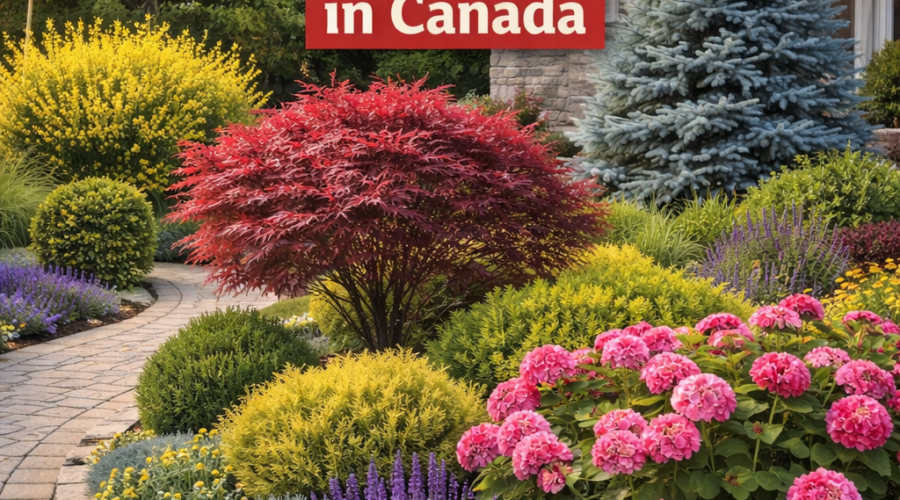
Best Trees and Shrubs for Year-Round Curb Appeal in Canada
There’s a particular kind of front yard that always seems to look good. Not just in July when everything is in bloom, not just in that brief perfect window of early fall color, but genuinely good in every month of the year. Drive past one of these yards in February, and it still has something going on. Structure, color, interest. It doesn’t look abandoned the way so many Canadian front yards do once the snow arrives.
The secret behind those yards is almost always the same thing. Somebody made good decisions about trees and shrubs.
Flowers are wonderful. Annual color has its place. But flowers come and go in a matter of weeks, and annuals disappear completely by October. Trees and shrubs are what give a front yard its permanent character. They’re what you see from the street in January. They’re what frames the house in every photograph ever taken of it. They’re the foundation on which everything else is built.
Getting that foundation right in Canada means thinking differently from homeowners in milder climates. You’re not just choosing what looks good in summer. You’re choosing what holds up through brutal winters, performs through short springs, and still has something to offer on a grey November afternoon. That narrows the field considerably — and actually makes the decisions easier once you understand what you’re looking for.
What Makes a Tree or Shrub Worth Planting in a Canadian Front Yard
Before getting into specific plants, it’s worth being clear about what the bar actually is for a Canadian front yard.
Year-round interest is the non-negotiable. A tree or shrub that looks spectacular for six weeks and then contributes nothing for the other ten months is a poor investment in a Canadian front yard. You need plants that earn their space across multiple seasons — ideally all four.
Hardiness is obvious but worth stating. Whatever you plant needs to handle your zone without special protection or coddling. A plant that survives Canadian winters is not the same as a plant that thrives in them. Look for plants that are rated at least one full zone colder than where you live to give yourself a real margin of safety.
Scale matters more than most people account for when they’re standing in a garden center looking at a small plant in a pot. That cute little tree that’s two feet tall right now might be forty feet tall in twenty years. Getting the mature size right relative to your house and your lot is one of those decisions that is very difficult to undo later.
Low maintenance is the final filter. Front yard trees and shrubs that require constant pruning, spraying, or intervention to look decent are not the right choice for most homeowners. The best plants for Canadian front yards are the ones that do their job without needing you to hover over them.
Serviceberry — The Canadian Front Yard Tree That Does Everything
If there is one small tree that belongs in more Canadian front yards than it currently occupies, it’s Serviceberry. Also called Amelanchier, this native Canadian tree delivers something genuinely interesting in every season of the year, and it does so without any fuss whatsoever.
In early spring — often before any other tree has woken up — Serviceberry covers itself in delicate white flowers that look spectacular against the grey skies of April. The show lasts a couple of weeks, and it’s one of the earliest signs of life in the whole neighborhood. Then, through early summer, it produces small edible berries that ripen from red to deep purple and attract birds in remarkable numbers. By fall, the foliage turns brilliant shades of orange and red that rival anything the maple family produces. And through winter, the smooth grey bark and elegant branching structure give it a sculptural quality that looks genuinely beautiful under snow.
It grows to a manageable size — typically 15 to 25 feet, depending on the variety — that works well in most Canadian front yards without overwhelming the house. It handles a wide range of soil conditions, tolerates both full sun and partial shade, and is native to most of Canada, making it well adapted to local conditions without any special treatment.
Plant it as a specimen tree where it has room to be appreciated from the street, or use multi-stemmed varieties as large shrubs to anchor a corner of your front-yard planting.
Cedar — The Workhorse of Canadian Curb Appeal
Eastern White Cedar has been a fixture in Canadian landscapes for so long that it’s easy to underestimate how good it actually is. When it’s well chosen for the space and properly maintained, it delivers a year-round green structure that no other plant quite matches at its price point.
As a privacy screen or hedge along a property edge, cedar is unbeatable in Canadian conditions. It fills in densely, holds its form well with minimal pruning, and stays deep green through even the harshest winters. As an upright specimen — varieties like Smaragd are particularly good for this — it provides a clean vertical accent that works beside a front door or at the corners of a garden bed.
The key with cedar in Canadian front yards is getting the placement right from the start. Cedar in full sun stays dense and healthy. Cedar struggling in heavy shade gets thin and patchy over time and never fully recovers. Give it the light it needs, and it will perform reliably for decades with almost no attention required from you.
One practical note worth mentioning. Cedar near driveways and roads takes a beating from winter road salt spray. If you’re planting cedar close to a driveway edge, either choose a salt-tolerant variety specifically or plan to wrap it in burlap during the worst of the salt season to protect the foliage.
Blue Spruce — Drama and Structure That Holds All Winter
Colorado Blue Spruce earns its place in Canadian front yards almost entirely on the strength of its winter performance. Through the months when everything else has either died back or gone dormant, the silvery blue foliage of a well-grown Blue Spruce looks striking against a white snow background in a way that is genuinely hard to replicate with any other plant.
It’s a slow grower, which is either a virtue or a frustration depending on your perspective. The upside is that it stays at a manageable size for many years after planting, giving you time to work your landscape around it before it becomes a significant presence. The downside is that you won’t get the full effect immediately. Plant it knowing you’re making a long-term investment in the structure of your front yard.
Globe Blue Spruce — with its rounded, compact form — is particularly useful in front-yard situations where a full-sized tree would eventually become too large. It grows to around four or five feet in both height and spread, holds a naturally rounded shape without pruning, and provides that distinctive blue color at a scale that works in most residential front yard beds.
The silvery-blue coloring looks best when the plant receives full sun. In shadier spots, the color tends toward more conventional green, and much of the visual drama is lost. Site it where it gets direct sun for most of the day, and it will hold that distinctive color year-round.
Dogwood — Winter Color That Surprises Everyone
Most people know Dogwood as a flowering tree. In Canadian front yards, the shrub forms — particularly Red Osier Dogwood and Yellow Twig Dogwood — deserve far more attention than they typically receive, especially for the contribution they make in winter.
Through summer, these shrubs are pleasant enough — clean green foliage, clusters of small white flowers, reasonable structure. Nothing extraordinary. But in the fall, when the leaves drop, and the bare stems are revealed, something remarkable happens. Red Osier Dogwood turns a vivid, almost fluorescent red that looks genuinely startling against snow. Yellow Twig Dogwood does the same in bright yellow. Planted together, they create a two-toned winter display that is one of the most eye-catching things you can put in a Canadian front yard during the grey months.
The stem color is brightest on younger growth. Cutting the shrub back hard every two or three years — a process called coppicing — keeps the new growth coming and maintains the intense color. Left unpruned, the stems gradually lose their vibrancy as they age.
Plant Dogwood where it can be seen clearly from the street in winter. Near the front pathway, flanking the driveway entrance, or as a foundation planting against a neutral coloured house — all of these placements maximize the visual impact of the winter stem color when it matters most.
Hydrangea — Summer Impact With Reliable Winter Structure
Hydrangeas have become enormously popular in Canadian gardens over the past decade, and the best varieties genuinely deserve the attention. For front yard use specifically, the Panicle Hydrangea — varieties like Limelight, Little Lime, and Bobo — are the ones worth focusing on.
Unlike the more tender Bigleaf Hydrangeas that can struggle with Canadian winters, Panicle Hydrangeas are reliably hardy to Zone 3 and sometimes colder. They bloom on new wood, which means even if they suffer some winter dieback, the bloom isn’t affected — the plant grows new stems that season and flowers on those.
The blooms start creamy white in midsummer and age gradually from pink to deep rose, eventually to a warm parchment color in fall. Cut stems left standing through winter hold their shape and provide real textural interest in the garden during the quiet months — particularly beautiful when covered in frost or a light dusting of snow.
Panicle Hydrangeas work well as specimen shrubs in a front yard bed, as informal hedges along a property edge, or flanking a front entrance, where the large flower heads create a genuinely welcoming impression throughout the summer and fall.
Mugo Pine — The Low-Maintenance Anchor Every Bed Needs
Every front yard needs at least one plant that sits there looking good without asking anything of you. Mugo Pine is that plant.
It grows slowly into a dense, rounded mound of dark green needles that holds its shape naturally without any pruning. It handles full sun, poor soil, dry conditions, and extreme cold without complaint. It stays green and tidy through every Canadian winter. It doesn’t get diseases or pest problems that require attention. It simply occupies its space, looking solid and well-kept year after year.
Mugo Pine is particularly useful at the corners of garden beds where you need a low anchor plant that provides structure without growing out of control. The dwarf varieties stay under three feet for many years, giving you a reliable presence in the bed without eventually taking over the space.
It won’t win any awards for dramatic seasonal interest. But that reliability and permanence are exactly what make it valuable. In a front-yard planting where other elements provide the seasonal color and drama, Mugo Pine is the steady foundation that makes everything around it look more intentional and composed.
Putting It Together
The front yards that look genuinely good in every month of the Canadian year are the ones where someone thought carefully about layering. Tall trees for height and canopy. Medium shrubs for structure and seasonal interest—low compact plants to anchor the edges and corners.
Start with one good tree: Serviceberry is the best single recommendation for most Canadian front yards. Add structure with cedar or Blue Spruce. Bring winter color with Dogwood. Fill in with Hydrangea for summer impact and Mugo Pine for year-round ground-level structure.
Build it gradually if needed. Add one element each season. The plants establish and grow, and the whole picture comes together over a few years in a way that looks completely natural and considered.
The trees and shrubs you plant today are the front yard you’ll have in ten years. Choose them as it matters — because it does.
Start with one good tree this season. Get it placed right and planted properly. Everything else you add after that will have something worth building around.