
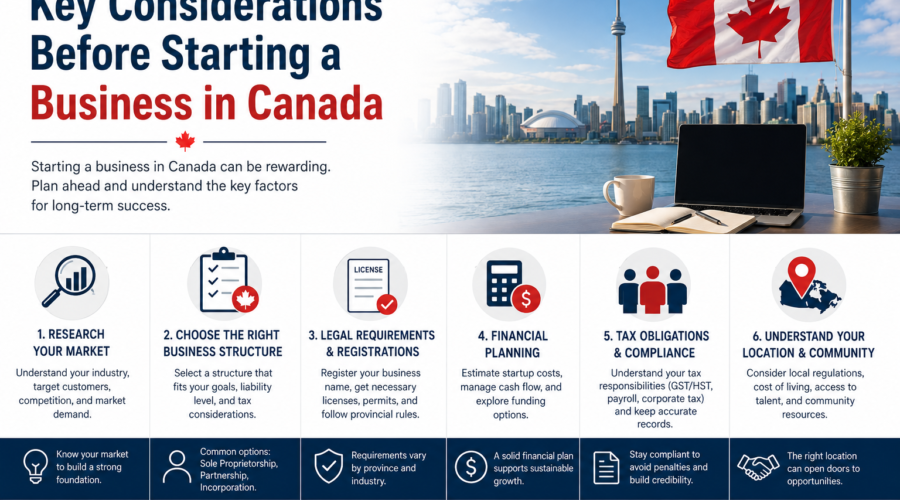
Key Considerations Before Starting a Business in Canada
So you want to start a business in Canada. Maybe you’ve been sitting on an idea for months. Maybe you’ve already told a few people about it, and they said, “You should really do that.” Maybe you’re tired of building someone else’s dream, and you’re ready to start working on your own.
Whatever brought you here, welcome. But before you register a name and order business cards, there are some things worth thinking through carefully. Starting a business is exciting — it’s also one of the more complicated things you’ll do in your life. The people who survive the first few years aren’t always the ones with the best ideas. They’re usually the ones who went in with their eyes open.
Here’s what actually matters before you leap.
Do You Know Your Market, or Do You Think You Do?
This is where most people get tripped up. They have a product or service they genuinely believe in, they’ve talked to a few friends who said they’d buy it, and they take that as proof of demand. It isn’t.
Real market research means talking to strangers, not just people who care about you. It means understanding who your actual customer is — their age, income, habits, where they spend money, and what problem they’re trying to solve. It means figuring out whether that problem is painful enough that they’d actually pay someone to fix it.
Canada’s population is spread across a huge geography with real regional differences. What sells well in Calgary doesn’t necessarily land the same way in Halifax. Urban markets behave differently from rural ones. If you’re planning to operate locally, study your local market specifically, not national trends that may or may not apply to your neighborhood.
What Structure Makes Sense for Your Business?
Before you can legally operate, you need to decide how your business will be structured. In Canada, the main options are sole proprietorship, partnership, and incorporation. Each one comes with different implications for taxes, liability, and paperwork.
A sole proprietorship is the simplest. You and the business are essentially the same legal entity. It’s cheap to set up and easy to manage, but if something goes wrong — a lawsuit, a debt you can’t pay — your personal assets are on the line.
A corporation is a separate legal entity from you. It offers liability protection and can have tax advantages as your business grows, but it also comes with more administrative responsibilities and higher setup costs.
There’s no universally right answer. A freelancer just starting has different needs than someone launching a product company that’ll take on investors. Talk to an accountant and a lawyer before you decide — ideally before you file anything.
Taxes Are Not Something to Figure Out Later
Many first-time business owners in Canada treat taxes as something they’ll deal with at year-end. That’s a mistake that causes real pain.
From day one, you need to understand what you’re responsible for. If your revenue will exceed $30,000, you’re required to register for GST/HST and collect it from customers. Some provinces have additional sales taxes. If you have employees, you’re responsible for payroll deductions — CPP contributions, EI premiums, and income tax withholding. These aren’t optional, and the CRA doesn’t have much patience for “I didn’t know.”
Beyond compliance, you need a basic system for tracking income and expenses from the start. A shoebox full of receipts at tax time is not a system. It’s a headache that costs you money in accountant hours and missed deductions. Set something up early, even if it’s simple.
How Long Can You Actually Last Without Income?
This is the conversation nobody wants to have with themselves, but it’s one of the most important ones.
Most businesses don’t turn a meaningful profit in their first year. Some take two or three years to get there. During that time, you still have rent, groceries, phone bills, and every other expense of being alive. Do you have savings to cover that runway? A partner whose income can carry the household for a while? A part-time job you can keep going while you build?
There’s no shame in building slowly. Many successful Canadian businesses started as side projects that became full-time only when revenue justified it. Knowing how long your financial runway is — and being honest about it — will shape every decision you make in those early months.
Have You Actually Looked at Your Competition?
Whatever you’re planning to sell, someone else is probably already selling something similar. That’s not automatically a problem — competition usually means there’s a real market. But you need to know who those competitors are, what they charge, how they reach customers, and where they fall short.
The question isn’t just “can I do what they do?” The better question is “why would someone choose me over them?” If you can’t answer that clearly and specifically, you don’t have a positioning strategy yet. You’re just hoping people will find you.
Study your competitors seriously. Read their reviews. Buy their product if you can. Talk to their customers if you get the chance. The information is out there — most people don’t bother to collect it before they launch.
Licenses, Permits, and Rules That Vary by Province
Canada is a federation, which means the rules for running a business aren’t the same across the country. Federal regulations apply across the country. Provincial rules vary by province. Municipal bylaws vary by city; depending on what you’re doing and where, you may need licenses, permits, inspections, or certifications before you can legally operate.
A food business in Ontario has different requirements than one in British Columbia. A contractor working in Quebec faces different regulations than one working in Alberta. If you’re operating from home, your municipality may have rules about that, too.
This isn’t meant to scare you — it’s just worth knowing that compliance isn’t one-size-fits-all in Canada. Do your industry- and location-specific research before you open your doors.
The People Around You Matter More Than You Think
Starting a business is isolating in ways that are hard to predict until you’re in it. The decisions don’t stop. The uncertainty doesn’t lift. And unlike a regular job, there’s no manager to escalate problems to — you are the manager.
Having a mentor, an advisor, or even just a small group of other entrepreneurs you can talk to honestly makes a genuine difference. Canada has a strong ecosystem of support for small businesses — organizations like the Business Development Bank of Canada (BDC), local Chambers of Commerce, and provincial small business centers all offer resources, guidance, and, in some cases, funding.
Use those resources. Nobody builds a business entirely alone, and the ones who try usually take longer and make more expensive mistakes than they need to.
One Last Thing
Starting a business in Canada is absolutely doable. Thousands of people do it every year, many of them with fewer resources and less experience than you might think necessary. The country has a functioning legal system, accessible financing options, and a culture that generally respects people who try to build something.
But the ones who make it aren’t just passionate — they’re prepared. They did the uncomfortable homework before launch day. They knew their numbers, understood their market, sorted out their legal obligations, and gave themselves enough runway to get through the hard early stretch.
Take the time to think it through properly. Your future self will be glad you did.