
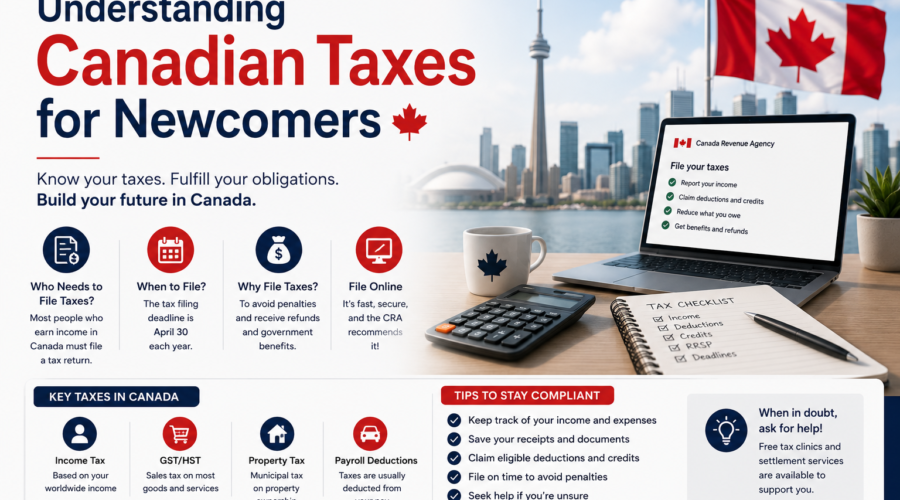
Understanding Canadian Taxes for Newcomers
Taxes in Canada can feel overwhelming when you first arrive. The system is different from what most newcomers are used to back home, and the rules around who pays what, when, and how can take a little while to get your head around. The good news is that once you understand the basics, Canadian taxes are actually quite manageable — and filing your return every year can put money back in your pocket through credits and benefits you may not even know you are entitled to.
This guide walks you through everything you need to know as a newcomer to Canada, in plain language.
How the Canadian Tax System Works
Canada uses a self-assessment tax system. That means it is your responsibility to file a tax return each year, reporting your income and calculating how much tax you owe — or how much the government owes you as a refund.
Taxes in Canada are collected at two levels: federal (by the Government of Canada) and provincial or territorial (by the province or territory where you live). Both levels tax your income, and both are filed together in a single annual return. So if you live in Ontario, you pay federal tax plus Ontario provincial tax — but you file one return that covers both.
The agency that manages all of this is the Canada Revenue Agency, commonly known as the CRA.
When Do You Become a Tax Resident?
This is the first question every newcomer needs to answer, because it determines your obligations.
In Canada, tax residency is based on your residential ties — not just your immigration status. The moment you establish significant ties to Canada (a home, a spouse or partner living here, a bank account, a driver’s license), you are generally considered a tax resident. This means you are required to report your worldwide income to the CRA, not just income earned in Canada.
If you arrived partway through the year, you are considered a part-year resident. You report your Canadian income from the date you arrived, and your global income only for the period you were a resident.
The Tax Year and Filing Deadline
The Canadian tax year runs from January 1 to December 31. Your tax return for any given year is due by April 30 of the following year. So your 2024 taxes are due April 30, 2025.
If you are self-employed, the deadline to file extends to June 15 — but any taxes owed are still due by April 30. Missing the deadline when you owe money results in late-filing penalties and interest charges, so it is worth marking the date in your calendar well in advance.
What Income Do You Need to Report?
As a Canadian tax resident, you must report all income from all sources worldwide. This includes:
- Employment income — your salary or wages from any employer in Canada
- Self-employment income — if you freelance, drive for a rideshare service, or run any side business.
- Rental income — if you rent out a property
- Investment income — interest, dividends, and capital gains
- Foreign income — income earned abroad, including from a job you held before arriving in Canada or from investments back home
Many newcomers are surprised to learn that foreign income must be declared. Canada has tax treaties with many countries, including India, which help prevent you from being taxed twice on the same income — but you still need to report it.
Understanding Tax Brackets
Canada uses a progressive tax system, which means higher income is taxed at higher rates. For 2024, the federal tax brackets look like this:
- Up to $55,867 — 15%
- $55,867 to $111,733 — 20.5%
- $111,733 to $154,906 — 26%
- $154,906 to $220,000 — 29%
- Over $220,000 — 33%
Provincial rates are added to this. The combined federal and provincial rate varies by province, but in most cases ranges from around 20% at lower income levels to over 50% at the very top.
Importantly, these rates apply only to income within each bracket—not to your entire income. If you earn $70,000, only the amount above $55,867 is taxed at 20.5%. The rest is taxed at 15%.
Credits and Benefits You Should Know About
One of the best-kept secrets of the Canadian tax system is how much you can get back through credits and benefits. As a newcomer, make sure you are aware of these:
GST/HST Credit — A tax-free quarterly payment from the federal government for low and modest-income individuals and families. You are automatically considered for this when you file your return.
Canada Child Benefit (CCB) — If you have children under 18, you may be eligible for monthly tax-free payments to help with the cost of raising them. The amount depends on your income and the number of children.
Basic Personal Amount — Every Canadian resident gets a non-refundable tax credit on the first portion of their income, reducing the tax you owe.
Tuition and Education Credits — If you or a family member is studying at a Canadian institution, tuition fees can be claimed as a credit.
RRSP Contributions — Contributing to a Registered Retirement Savings Plan reduces your taxable income for the year. It is one of the most effective legal ways to pay less tax.
How to File Your Taxes
Most Canadians file their taxes using NETFILE-certified software, which lets you file your return directly with the CRA online. Popular options include TurboTax, Wealthsimple Tax (free), and H&R Block.
If your tax situation is simple — you have one employer and no major investments — free software like Wealthsimple Tax is perfectly adequate. If you have foreign income, rental properties, or self-employment income, it may be worth working with a tax accountant, at least for your first year, to make sure everything is filed correctly.
The CRA also runs a free tax clinic program called the Community Volunteer Income Tax Program (CVITP), where trained volunteers help eligible individuals file for free. Many settlement agencies and community centers across Canada participate in this program — worth checking if you are in your first year and not sure where to start.
A Few Things Newcomers Often Get Wrong
Not filing because you think you owe nothing. Even if you had very little income in your first year, filing your return is important. It activates your eligibility for benefits like the GST credit and CCB, and establishes your record with the CRA.
Forgetting to report foreign income. As mentioned, worldwide income must be declared. Forgetting this — even accidentally — can lead to penalties down the road.
Missing out on the first-year deductions. Moving expenses, for instance, can sometimes be deducted if you moved to Canada to work or study. Keep your receipts.
The Bottom Line
Canadian taxes are not as intimidating as they first appear. The system is designed to be filed by ordinary people; there are free tools to help you do it, and filing regularly — even in years when you owe nothing — is what keeps you in good standing with the CRA and ensures you receive all the benefits you are entitled to.
Take it one year at a time. File on time, report everything accurately, and do not leave money on the table by skipping credits and benefits that are rightfully yours.